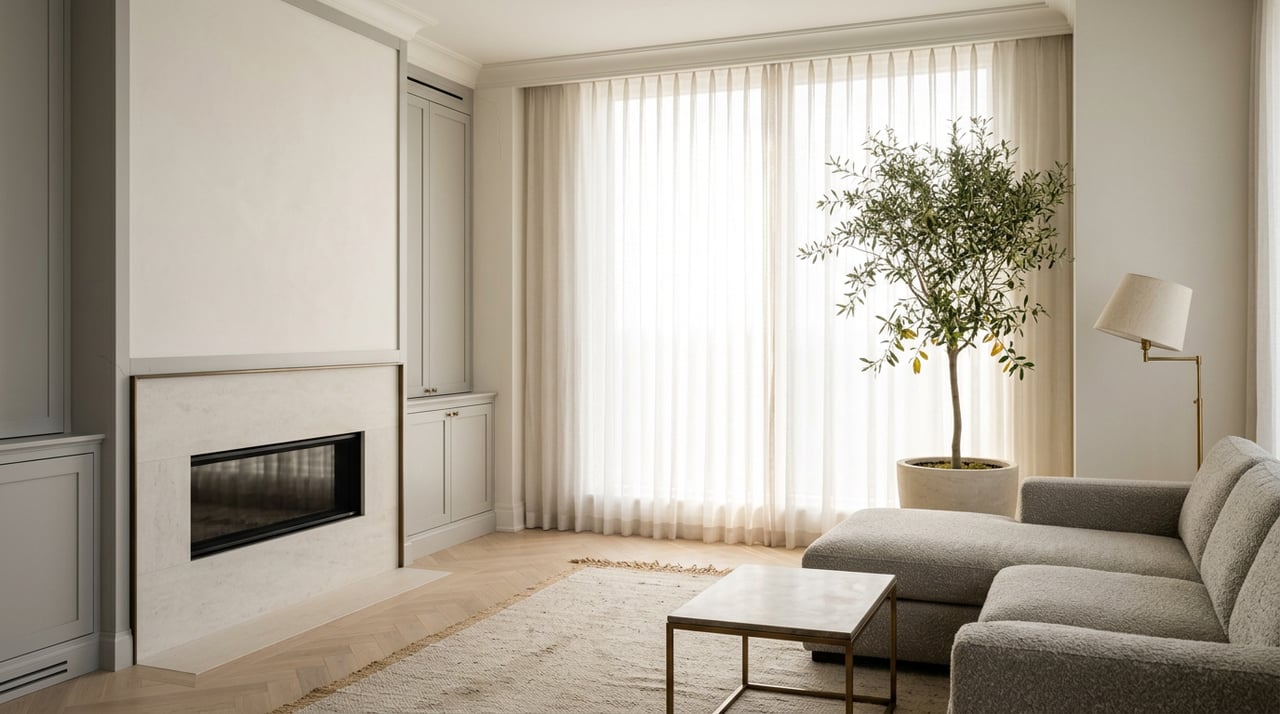
The Galleria Condo Market Is Now Pricing Two Different Bets, Not One Home
September 10, 2026
September 10, 2026
Walk into the sales gallery at 2120 Post Oak Boulevard and you're standing in a $5 million room built just to sell condos that don't exist yet. The finishes on display, the stone, the bronze fixtures, the layout mockups, all mirror what's coming in the actual tower once it's finished. At the launch party this spring, guests moved through a tented space with hardwood floors and crystal chandeliers while Houston's David Caceres Trio played. Drive fifteen minutes away and you can tour a resale unit in a 1980s Galleria high-rise for a fraction of the price, no gallery required, no live music, just a listing agent and a set of HOA documents you'll need to actually read.
Both are "Galleria condos." They are not competing for the same buyer, and lately they're not even describing the same market. If you're comparing Galleria condo prices to what you'd pay in another Houston neighborhood, the number you're probably looking at is telling you less than you think.
As of September 2026, the median sale price for a condo in the Uptown-Galleria area sat at $324,000. The average sale price for the same area, same month, was $735,862. That's not a rounding gap. It's more than double.
| Metric (Uptown-Galleria, Sept. 2026) | Value |
|---|---|
| Median sale price | $324,000 |
| Average sale price | $735,862 |
| Active listings | 311 |
| Price range | $64,000 to $27,500,000 |
| Average days on market | 62 |
A median tells you what the typical transaction looks like. An average can be pulled far off course by a small number of very large numbers. In a market with 311 active listings ranging from $64,000 studios to a $27.5 million penthouse, a handful of eight-figure sales can drag the average hundreds of thousands of dollars above what most buyers are actually paying. That's exactly what's happening here, and it has a name and an address.
The Ritz-Carlton Residences, Houston is a 45-story tower under development at 2120 Post Oak Boulevard, developed by Deiso Moss in partnership with Cleary Interests, with sales led by Redeavor Group. It pairs a 156-room Ritz-Carlton hotel with 112 privately owned residences, architecture by Pickard Chilton and interiors by Rottet Studio. Public sales launched in early March 2026, with pricing starting in the low $3 million range. By August 2026, the project had recorded more than $200 million in sales, including a top-floor penthouse under contract for $30 million, one of the highest condo transactions ever recorded in Texas. Completion is targeted for fall 2029.
Do the math on what that does to an area average. A single tower selling a fraction of its 112 units in the $3 million to $30 million range, layered on top of an existing resale market where most units trade well under $500,000, will move the average far faster than it moves the median. The median barely notices, because most of the 311 active listings are still ordinary resale units. The average notices immediately, because averages are sensitive to exactly the kind of outlier the Ritz-Carlton Residences represents.
This matters if you're using "average Galleria condo price" to size up the neighborhood against Katy, Sugar Land, or the Energy Corridor. You're not comparing typical homes. You're comparing a number that includes a small number of $3 million-plus new construction sales against markets that mostly don't have that kind of product yet.
Strip out the new luxury supply and the median buyer is shopping something else entirely: an existing high-rise or mid-rise, likely built decades ago, competing on amenities that were considered standard when it opened. Uptown-Galleria has one of the highest concentrations of pool buildings in the city, which sounds like a perk until you realize pools mean staffing, and staffing is one of the largest line items in a monthly HOA budget. Condos in the area are spending an average of 62 days on market as of September 2026, longer than a hot single-family market, which gives buyers more room to ask questions before writing an offer.
The questions worth asking aren't about the pool. They're about what's underneath the monthly number on the listing sheet.
Houston ranks third nationally for the share of homeowners paying HOA or condo fees, according to an April 2026 LendingTree analysis, with more than half of Houston-area homeowners paying some form of HOA assessment. In upscale towers like the ones clustered around the Galleria, monthly fees commonly land between $500 and $1,000, well above the low fees typical of single-family HOAs elsewhere in the metro.
A high fee by itself isn't a red flag, and a low one isn't a bargain. Fees fund two very different things: day-to-day operations like landscaping, staffing, and insurance, and a reserve fund meant to cover major future repairs like roofs, elevators, and building envelopes. Texas condo associations have historically leaned on an old rule of thumb, setting reserve contributions at roughly 10% of the operating budget, a method that predates the scale of repairs modern high-rises actually need. Nationally, a large share of community associations carry reserves that fall short of what a proper reserve study says they need, and when a major repair lands on an underfunded building, a special assessment is usually the result, sometimes running into tens of thousands of dollars per unit with little warning.
Two units can list at the same price, in buildings with nearly identical monthly fees, and carry completely different exposure depending on how well each building's reserve fund is actually funded. The listing price won't tell you. The fee won't tell you. The reserve study will.
Here's the trade-off the average-versus-median split is actually describing. Buy into a brand-new tower like the Ritz-Carlton Residences and you're paying a premium, starting in the low $3 millions, but you're also buying a building with no deferred maintenance and reserves that start from zero deficit on day one. Buy at the median, in an established Galleria high-rise, and you're paying a fraction of that price, but you're inheriting decades of decisions other owners and boards made about how much to save.
Neither choice is automatically the right one. But only one of them is fully priced into what you see on the listing.
Before comparing any resale Galleria condo to a home anywhere else, request:
Does buying new construction guarantee I'll never face a special assessment? No. New buildings start with a clean slate on deferred maintenance, but poor budgeting or an early, unexpected repair can still lead to an assessment years down the road. New construction lowers the odds. It doesn't eliminate them.
How do I actually get a reserve study before making an offer? Request it through the seller or listing agent as part of your due diligence period, alongside the resale certificate and recent board minutes. A licensed agent familiar with Houston high-rises can help you know what's missing from what you're handed.
Is a lower monthly HOA fee always a warning sign? Not always, but it's worth asking why the fee is low. Sometimes it reflects fewer amenities or lower staffing needs. Sometimes it reflects a board that's been keeping dues artificially low instead of funding reserves properly. The fee alone won't tell you which one you're looking at.
If you're weighing a Galleria condo against a home in Memorial, Katy, or anywhere else in the JL Fine Homes footprint, the comparison only works once you're pricing the same thing. JL Fine Homes can pull the reserve study, the board minutes, and the resale certificate before you write an offer, not after. Schedule a consultation and let's look at what the number on the listing isn't telling you.
Stay up to date on the latest real estate trends.
Our philosophy is simple, we'll always ask the right questions, provide the right answers, treat everyone honestly, and only promise what we are confident we can deliver.
JL FINE HOMES
12525 MEMORIAL DR STE 350 HOUSTON TX 77024